
Lead Paint Removal and Lead-Safe Renovation in Ohio
Because the Building You’re Standing In Changes the Rules
Lead paint problems are not all the same.
That is where many people — contractors, property managers, business owners, and even parents — get tripped up. Most people assume lead is lead and the rules should be the same everywhere. They are not.
Lead regulations change depending on:
- the building
- who occupies it
- what work is being performed
- how materials are disturbed
- whether federal funding is involved
- how exposure is handled and enforced
At HEPA Environmental Services, we help people understand those differences and make smart decisions before a project turns into a problem.
Stand in a different building, and the law can change.
Why Lead Compliance Feels So Confusing
There isn’t just one rulebook — and that’s the root of the problem.
Most projects involving lead fall under a mix of:
- OSHA — focused on protecting workers
- EPA RRP — focused on protecting occupants during renovation
- HUD — focused on federally assisted housing
- Ohio Department of Health (ODH) — focused on public health and enforcement
Here’s what most people don’t realize:
👉 OSHA applies to construction work involving lead in almost every type of building.
👉 ODH often gets involved after exposure happens — especially when children are affected.
That’s why this gets confusing fast. Lead may be the same material everywhere — but the rules around it are not created equally.
Same Lead Paint. Completely Different Rules.
This is where it clicks.
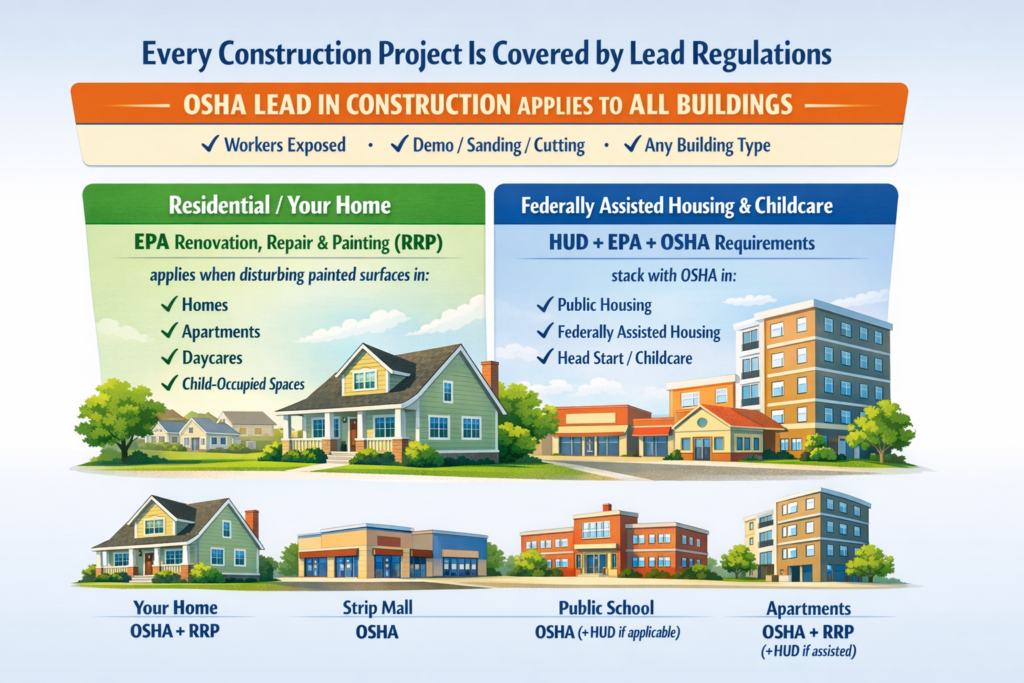
🏠 Your Home (Pre-1978 Renovation) Replacing windows, sanding trim, or opening walls?
Now you’re in EPA RRP territory. The focus shifts to protecting your family from lead dust.
🏠 Government Housing (Families Living There)
Add federal involvement and long-term occupancy — now HUD enters the picture along with OSHA. More oversight. More responsibility.
🧸 Daycare or Child-Occupied Facility
Same type of work — but now children are involved.
That raises the stakes significantly because children are far more vulnerable to lead exposure.
🛍️ Strip Mall Renovation (Retail Space)
A contractor is renovating a nail salon, pizza shop, or storefront.
Now the primary concern is worker exposure under OSHA — but poor practices can still affect employees and customers.
👉 And here’s the part most people miss:
If a child tied to any of these environments shows elevated blood lead levels, the Ohio Department of Health can step in — no matter how the job started. Same paint. Same tools. Same type of work.
Different building. Different people.
👉 Different rules — and different consequences.
So… Which Lead Regulation Actually Applies?
Short answer: it depends.
Not on the paint — but on the situation.
Ohio Department of Health Public health enforcement Elevated blood lead levels
👉 There’s rarely a true “exemption.” The real question is: which rules apply here?
Does the Building Really Matter That Much? Yes — more than anything else.
Here’s how the exact same job can change:
| Scenario | What Applies |
| Your home (pre-1978) | EPA RRP + OSHA |
| Government housing | HUD + OSHA + ODH |
| Daycare | EPA RRP + OSHA |
| Strip mall retail | OSHA |
The paint didn’t change. 👉 The building did — and that changes everything.
Where the Ohio Department of Health Comes In
This is where things get real.
The Ohio Department of Health doesn’t usually show up at the beginning of your project. They show up when something goes wrong.
ODH steps in when:
- children show elevated blood lead levels
- exposure needs to be investigated
- properties are identified as sources
- landlords or owners are required to act
That can lead to:
- inspections
- required remediation
- tenant involvement
- enforcement actions
👉 This is why getting it right on the front end matters.
How HEPA Looks at a Lead Project
We don’t start with “Is there lead?”
We start with: 👉 “Who could be affected — now and later?”
From there:
- What building are we in?
- Who is exposed?
- What work is being done?
- Which regulations apply?
- What’s the smartest way to do it safely?
Simple questions — big impact.
- Lead Services We Provide:
Lead paint removal - Lead-safe renovation support
- Residential renovation projects
- Retail and commercial renovations
- Daycare and school work
- Government and housing projects
- Interior selective demolition
- Dust control and containment planning
- Regulatory guidance and planning
Frequently Asked Questions
Is lead handled the same in every building?
No. The rules change depending on the building, the people inside, and the work being done.
Does OSHA apply everywhere?
In most cases, yes. OSHA applies broadly to construction work involving lead across almost all building types.
Does a retail job follow the same rules as a daycare?
No. A daycare introduces child exposure risk, which brings stricter controls, but don’t forget about OSHA
When does EPA RRP apply?
Typically in pre-1978 homes and child-occupied facilities during renovation work, and don’t forget about OSHA.
When does HUD apply?
When federally assisted housing is involved.
What does the Ohio Department of Health do?
ODH investigates elevated blood lead levels and enforces hazard control requirements — especially in residential settings.
Can ODH get involved after the job is done?
Yes. If exposure is discovered, they can step in after the fact and require corrective action.
Is it acceptable to expose future tenants, employees, or children to lead during renovation?
No — and that’s the question that should guide every project.
Lead compliance isn’t just about protecting workers today. It’s about protecting the people who will use the building tomorrow — tenants, employees, customers, and children.
Even short-term work can leave behind dust if it’s not handled correctly.
The real question isn’t: 👉 “Are you following the rules?”
It’s: 👉 “Are we preventing exposure for the people who come after us?”
Why This Matters
Getting lead wrong can lead to:
- project delays
- failed inspections
- exposure risks
- ODH investigations
- tenant issues
- lawsuits, liability, and cost
👉 Most problems don’t come from the lead itself.
They come from misunderstanding how the rules apply.
Final Thought: Lead doesn’t change. But the rules — and the consequences — do.
👉 It all comes back to one question: What kind of building are you standing in?