
The Hidden Linchpin of Crime: Why an Old House Might Hold a Terrifying Secret
I just finished reading Murderland: Crime and Bloodlust in the Time of Serial Killers by Caroline Fraser, and honestly, it will change the way you look at true crime forever. We often talk about “twisted minds” and psychological profiles, but Fraser’s book dives deep into a chilling environmental theory: the link between heavy metal contamination—specifically lead and arsenic—and the surge in violent crime that rocked American cities in the 70s and 80s.The Lead-Crime Connection
This isn’t just about paint chips. Fraser discusses industrial contamination, like the plumes from the ASARCO copper smelter in Tacoma, Washington, and how proximity to these toxic sites seems to correlate with the backgrounds of some of the Pacific Northwest’s most notorious killers, including Ted Bundy and Gary Ridgway. It’s a shocking idea: that environmental poison literally made a generation more prone to violence.
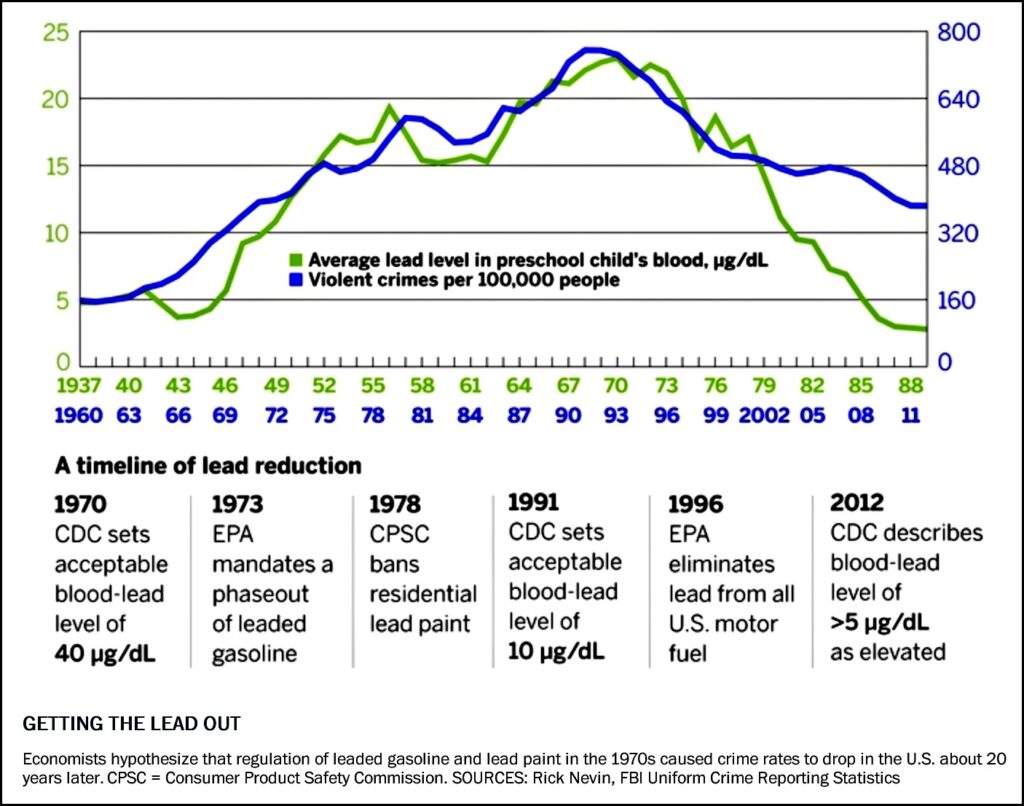
This is all part of the larger Lead-Crime Hypothesis, which suggests that lead poisoning, especially in early childhood, degrades the developing brain. It attacks impulse control and impairs the executive functions that allow people to understand the consequences of their actions.
As Kevin Drum detailed in his 2018 Mother Jones article, “An Updated Lead-Crime Roundup for 2018,” the evidence is overwhelming. Drum argues that the rise in atmospheric lead from leaded gasoline after World War II perfectly maps to the surge in crime a generation later, and the subsequent phase-out of leaded gasoline in the 70s perfectly correlates with the massive, unexpected decline in violent crime that started in the 90s. The correlation is too strong to ignore. The Problem Isn’t Just History—It’s in Your Home.
While we’ve made progress on industrial and gasoline-based contamination, the poison of the past is still present—and it could be hiding in your house right now.
For homeowners, especially those with pre-1978 properties, the most significant risk is not the water, but the paint. Renovations are the number one way lead dust is accidentally released into your home today. Scraping, sanding, and tearing into old walls can turn dormant lead paint into invisible, airborne dust that contaminates everything and poses a serious risk to brain development, particularly for children.
We have the power to eliminate this “linchpin” for violence. We can remove one of the critical ingredients for a tragic future from the equation.
If you are planning any work that disturbs paint in an older home, you must test for lead first. Don’t turn your dream renovation into a health hazard. As I always say: You got to check it before you wreck it.
This is more than an environmental issue—it’s a long-term public health and safety issue. The greatest prevention tool against crime might just be a clean, lead-safe environment.
Rick Kuhlman, CEO HEPA Environmental Services